Every generation produces a new club of countries that claims to speak for the world, and every one of them was built by a smaller group that felt the old club couldn't do the job anymore. The G6 became the G8 because the old order needed more chairs. The G20 displaced the G8 because a financial crisis needed more balance sheets. BRICS formed because a bloc of rising economies wanted a table where the rules weren't already written. And now the Board of Peace exists because a group of states decided the UN Security Council's veto system had become an obstacle rather than a safeguard.
None of these institutions were built by consensus of the system they were replacing. Each one was built by the states the old system was failing to serve, at the moment failure became too expensive to ignore. That's not a coincidence repeating four times — it's the actual mechanism by which global governance evolves, and understanding it tells you more about what happens next than any single summit communiqué does.
The Pattern: Crisis, Exclusion, New Forum
Look across a century of institution-building and the sequence barely changes. A shock happens that the existing order can't absorb — a war, a financial collapse, a security failure that makes the incumbent institution look structurally unable to respond. The states most affected by that shock, usually not the ones running the incumbent institution, conclude that reform from within is slower than starting fresh. They build a new forum with membership rules that fix the specific exclusion that hurt them last time. The new forum doesn't abolish the old one. It just becomes where the real decisions happen, while the old institution keeps its seat, its budget and steadily less of its relevance.
This is worth stating plainly because most coverage of new institutions treats each one as an isolated news event — a summit here, a charter signing there — rather than as the latest instance of a mechanism that has run at least four times since 1975.
G6 to G8: A Cold War Order Runs Out of Chairs
The G8's own origin story is the cleanest version of the pattern. In 1975, six industrialised economies convened at Rambouillet because the postwar Bretton Woods exchange system had just collapsed and the oil shock had exposed how little coordination existed among market economies on monetary policy. It wasn't a UN process. It wasn't voted on by any existing body. Six finance-adjacent governments simply decided they needed a room the rest of the system didn't have, and built one. Canada was added the following year, Russia in 1998 — each addition a small negotiation over who counted as "the industrialised world" at that moment.
Notice what didn't happen: no one dismantled the IMF or the UN to make room for the G8. The new forum layered on top of the old architecture, doing the fast, informal coordination the treaty-bound institutions structurally couldn't.
G20: When the Club Got Too Small for the Crisis
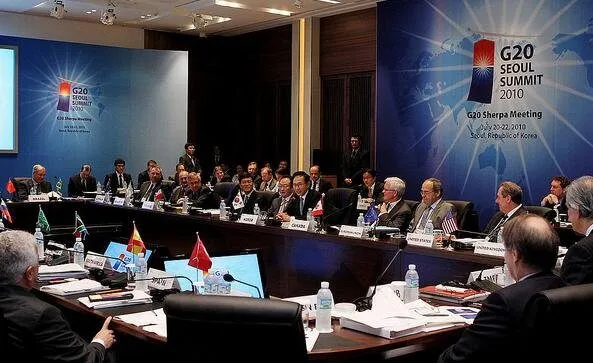
The same mechanism repeated in 2008, faster and more visibly. When Lehman Brothers collapsed, it became obvious within weeks that a crisis response confined to eight countries couldn't work — China alone held over $2 trillion in reserves the G8 had no mechanism to coordinate with. The G20, which had existed since 1999 as a finance-ministers' talking shop nobody outside Treasury departments had heard of, got promoted to leaders' level almost overnight and produced, at the 2009 London Summit, the largest coordinated economic intervention in history.
By the Pittsburgh Summit later that year, the G20 had formally declared itself the premier forum for international economic cooperation — a title the G8 had held by default for three decades. The G8 didn't disappear. It kept meeting, kept issuing communiqués, and kept steadily losing the economic-policy conversations to the room down the hall with twelve more countries in it.
BRICS: A Rejection Coalition Without a Single Trigger Event
BRICS breaks the pattern in one interesting way: there was no single Lehman-style shock that created it. Jim O'Neill's 2001 acronym became an actual summit in 2009 not because of one crisis but because of a slower, cumulative grievance — major emerging economies watching the G7 and Bretton Woods institutions set rules for a global economy in which those economies' share of output kept growing while their voting power inside the IMF and World Bank didn't. The 2023 expansion, adding five more states, followed the same logic: countries that felt structurally under-weighted in the existing order building their own room rather than waiting for a renegotiation of the old one.
Our G7 vs BRICS comparison covers the numbers; the mechanism point here is that BRICS proves the pattern doesn't require a single dramatic trigger. Chronic exclusion works just as well as acute crisis — it just takes longer to produce a new institution.
The Board of Peace: The Newest Data Point
The Board of Peace is the pattern's most recent and most legally consequential run. The trigger this time wasn't economic — it was the UN Security Council's repeated inability to act on crises where a permanent member had a direct interest, a structural flaw that predates the UN's founding but became newly intolerable to a specific group of Gulf and Global South states in 2025. Rather than push for Security Council reform — a process that has failed for three decades because it requires the consent of the very states whose veto power it would dilute — those states built independent financial commitments and a standing force outside the UN framework entirely.
That's the same move the G6 made in 1975 and the G20's founders made in 2008: don't wait for the incumbent institution to reform itself, build a parallel one with the specific capability the incumbent lacks. The Board of Peace's capability gap was enforcement without a veto. Whether that gap-filling move produces a durable institution or a short-lived one is still an open question — but the mechanism that produced it is not new.
Why Institutions Rarely Die, They Just Get Bypassed
A detail that gets lost in "old institution vs new institution" framing: the old one almost never actually shuts down. The G8/G7 still meets every year, forty years after the G20 took over its main function. The UN Security Council still exists, still issues resolutions, still matters enormously for the crises where its permanent members agree. What changes is where the binding decisions get made and where the money and political attention flow. Institutional death is rare. Institutional demotion is the norm, and it happens quietly enough that most coverage misses the moment it occurs.
This matters for reading the current moment correctly. The Board of Peace existing doesn't mean the UN Security Council has failed as an institution — it means one specific function of the Security Council, enforcement in cases blocked by a P5 veto, has been demoted to a role a newer, narrower institution now performs instead. The Security Council keeps everything else it does. That's exactly what happened to the G8's role in global economic coordination after 2008: it kept meeting, it just stopped being where the economic decisions got made.
The Cost the Pattern Doesn't Advertise
None of this is a case for institutional proliferation as a good thing in itself. Every new forum built by the excluded also creates a new opportunity for forum-shopping by the powerful — a state unhappy with a UN ruling can now look for a friendlier hearing at the Board of Peace, the way a state unhappy with a G7 statement could always find a more sympathetic room at the G20 or BRICS. More forums means more venues where a determined actor can find, or manufacture, the answer it already wanted. The G20's rise didn't just add representation; it also diluted the G7's ability to issue fast, unified statements on anything the G20's more heterogeneous membership disagreed on.
There's also a slower cost that doesn't show up in any single crisis: institutional attention is finite, and every new body competing for the same pool of foreign ministries, think tanks and journalists to staff, study and cover it thins out the scrutiny each one gets. A UN Security Council resolution gets analysed by a press corps that has covered it for eighty years. A three-year-old Board of Peace deployment decision gets a fraction of that scrutiny, not because it matters less, but because the expertise hasn't caught up yet. Newer institutions are, almost by definition, less watched than the ones they're bypassing — which is exactly when watching them matters most.
What the Pattern Predicts Next
If the mechanism holds, the next new institution won't come from inside the UN, IMF or WTO system trying to reform itself — it will come from whichever group of states currently feels most structurally excluded from an existing forum, once the cost of that exclusion crosses whatever threshold makes building a parallel institution cheaper than continuing to lobby for reform. Candidates aren't hard to name: African Union members frustrated by their absence from permanent Security Council seats, mid-sized economies excluded from both G7 and BRICS, or a coalition built specifically around AI governance, an area where no existing 20th-century institution has clear jurisdiction at all.
The one prediction the historical pattern rules out is stasis. Global governance doesn't resolve its legitimacy gaps through reform of the institutions that have them — see our Global Governance Comparison for how differently UN, G7, G20, EU, BRICS and the Board of Peace are each structured around a specific, unresolved exclusion. It resolves them, or at least routes around them, by building the next one.
For more analysis on international governance, explore our articles section.