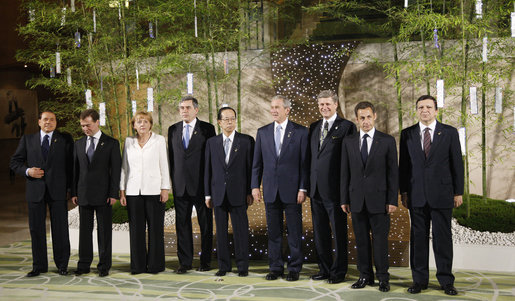
The Group of Eight — the G8 — has one of the most remarkable institutional histories in modern diplomacy. Born as an informal dinner among six leaders during an economic crisis, it grew into the world's most exclusive political club before being reshaped by geopolitical upheaval. Understanding this history is essential for grasping how international governance works today.
Origins: The Oil Crisis and the Birth of the G6 (1975)
In November 1975, French President Valéry Giscard d'Estaing invited the leaders of five other industrialised nations — the United States, the United Kingdom, West Germany, Japan and Italy — to a private meeting at the Château de Rambouillet, south-west of Paris. The world was reeling from the 1973 oil crisis, the collapse of the Bretton Woods fixed exchange rate system, and a severe global recession.
Giscard d'Estaing's idea was simple but revolutionary: bring together the leaders of the world's largest economies for frank, informal discussions without the bureaucracy of the United Nations or other international organisations. The Rambouillet Summit lasted two days and focused on monetary policy, energy prices and trade. It was deliberately intimate — leaders met without large delegations, fostering the personal relationships that would become the hallmark of the G6 process.
Expansion: G7 (1976) and the EU (1977)
Canada joined the group in 1976 at the insistence of the United States, creating the G7. The first G7 summit was held in San Juan, Puerto Rico. The following year, the European Community (now the European Union) began participating, initially represented by the President of the European Commission and later also by the President of the European Council.
Throughout the late 1970s and 1980s, the G7 summits became increasingly important events in the international calendar. They addressed the second oil shock (1979), the Latin American debt crisis (1982), and nuclear arms control. The Williamsburg Summit of 1983 and the Bonn Summit of 1978 demonstrated the G7's ability to coordinate macroeconomic policy among the world's largest economies.
The End of the Cold War and Russia's Path to G8 (1991–1998)
The fall of the Berlin Wall in 1989 transformed the G7's role. Soviet President Mikhail Gorbachev was invited to attend the London Summit in 1991, marking the beginning of Russia's gradual integration. Throughout the 1990s, Russia participated in an expanding range of G7 activities, first as a guest, then as a participant in political discussions (the “Political 8”).
At the 1997 Denver Summit, Russia was formally invited to join as a full member, and the group was rechristened the G8. The Birmingham Summit of 1998 was the first true G8 meeting. Russia's inclusion was driven by political considerations — rewarding Boris Yeltsin's democratic reforms and anchoring Russia in Western institutions — rather than economic logic, as Russia's GDP was smaller than that of the Netherlands.
The G8's Golden Age (1998–2008)
The decade following Russia's accession saw the G8 at the height of its influence. Key achievements include:
- 2001 – Genoa: Creation of the Global Fund to Fight AIDS, Tuberculosis and Malaria, despite massive anti-globalisation protests that overshadowed the summit.
- 2002 – Kananaskis: The Africa Action Plan and the G8 Africa Partnership, marking a shift toward development as a core G8 concern.
- 2005 – Gleneagles: The landmark debt relief initiative, cancelling $40 billion in debt owed by the world's poorest countries, and a pledge of $50 billion in additional aid by 2010. The summit coincided with the Live 8 concerts and the London bombings.
- 2007 – Heiligendamm: The first Heiligendamm Process, establishing a structured dialogue with five major emerging economies (China, India, Brazil, Mexico, South Africa).
- 2008 – Hokkaido Tōyako: Agreement on a 50% reduction in greenhouse gas emissions by 2050. However, the financial crisis that erupted weeks later shifted global economic coordination to the broader G20 forum.
Crisis and Decline (2008–2014)
The 2008 global financial crisis exposed the G8's fundamental limitation: it excluded the rising economic powers whose participation was essential for any meaningful response. When US President George W. Bush convened the first G20 leaders' summit in November 2008, the G8's claim to be the premier forum for economic governance was effectively ended.
The G8 continued to meet, but its agenda narrowed. Economic issues increasingly migrated to the G20, while the G8 focused on political and security questions where the like-mindedness of its Western members (plus Japan) was an advantage. The G8's informal structure still had value for addressing issues like counter-terrorism, non-proliferation and development.
Russia's Suspension and the Return to G7 (2014)
In March 2014, following Russia's annexation of Crimea, the other seven G8 members suspended Russia's participation. The planned Sochi Summit was cancelled, and the group met instead in Brussels in the G7 format. This was the most dramatic moment in the institution's history — for a detailed analysis, see our page on why Russia was suspended from the G8.
The suspension was initially presented as temporary, but as Russia's confrontation with the West deepened — particularly after the full-scale invasion of Ukraine in February 2022 — any prospect of Russia's return has been definitively abandoned.
The G7 Era (2014–Present)
Since 2014, the G7 has experienced a renaissance of sorts. Freed from the need to accommodate Russia, the group has been able to act more cohesively on issues like sanctions against Russia, support for Ukraine, and economic security. Recent summits have addressed AI governance, climate finance, global health security and the challenges posed by China's economic practices.
The G7 now positions itself as a values-based forum of advanced democracies, complementing the larger G20 on economic governance and the UN on broader multilateral issues. For a comparison of how these forums relate, see our G8 vs G20 analysis.
Complete Timeline of G8/G7 Summits
| Year | Summit | Host | Key Outcome |
|---|---|---|---|
| 2024 | Apulia | Italy | AI governance, Ukraine support |
| 2023 | Hiroshima | Japan | Nuclear disarmament, economic security |
| 2022 | Elmau | Germany | Price cap on Russian oil |
| 2021 | Carbis Bay | UK | 1 billion vaccine doses pledge |
| 2020 | Virtual (USA) | USA | COVID-19 response coordination |
| 2019 | Biarritz | France | Amazon fires, Iran diplomacy |
| 2018 | Charlevoix | Canada | Trade tensions, ocean plastics |
| 2017 | Taormina | Italy | Counter-terrorism, Africa partnership |
| 2016 | Ise-Shima | Japan | Quality infrastructure investment |
| 2015 | Elmau | Germany | Climate finance, global health |
| 2014 | Brussels | EU | Russia suspended; energy security |
| 2013 | Lough Erne | UK | Tax transparency, trade |
| 2012 | Camp David | USA | Euro crisis, food security |
| 2011 | Deauville | France | Arab Spring, Fukushima response |
| 2010 | Muskoka | Canada | Maternal and child health |
| 2009 | L’Aquila | Italy | $20B food security pledge |
| 2008 | Hokkaido Tōyako | Japan | 50% emission cut by 2050 |
| 2007 | Heiligendamm | Germany | Africa aid, climate, Outreach 5 |
| 2006 | St. Petersburg | Russia | Energy security, education |
| 2005 | Gleneagles | UK | Africa debt relief, $50B aid |
| 2004 | Sea Island | USA | Middle East, democracy promotion |
| 2003 | Évian | France | Water action plan, growth |
| 2002 | Kananaskis | Canada | Africa Action Plan |
| 2001 | Genoa | Italy | Global Fund for AIDS |
| 2000 | Okinawa | Japan | IT Charter, infectious diseases |
| 1999 | Cologne | Germany | Enhanced HIPC debt relief |
| 1998 | Birmingham | UK | First full G8 summit |
| 1997 | Denver | USA | Russia formally joins (G8) |
| 1996 | Lyon | France | HIPC Initiative, globalisation |
| 1995 | Halifax | Canada | IFI reform, Bosnia |
| 1994 | Naples | Italy | Russia partnership, Ukraine |
| 1993 | Tokyo | Japan | Russia aid, trade liberalisation |
| 1992 | Munich | Germany | Yeltsin attends, aid to Russia |
| 1991 | London | UK | Gorbachev invited, post-Cold War order |
| 1990 | Houston | USA | German reunification, environment |
| 1989 | Paris (Arche) | France | Tiananmen response, environment |
| 1988 | Toronto | Canada | Debt relief for poorest nations |
| 1987 | Venice | Italy | AIDS, terrorism, Intermediate-Range Nuclear Forces |
| 1986 | Tokyo | Japan | Chernobyl response, counter-terrorism |
| 1985 | Bonn | Germany | New trade round launched (Uruguay Round) |
| 1983 | Williamsburg | USA | Nuclear deterrence, economic recovery |
| 1982 | Versailles | France | Technology, East-West trade |
| 1981 | Ottawa/Montebello | Canada | North-South relations, energy |
| 1980 | Venice | Italy | Second oil shock, Afghan crisis |
| 1979 | Tokyo | Japan | Oil import limits, Indochina refugees |
| 1978 | Bonn | Germany | Coordinated fiscal expansion (“locomotive theory”) |
| 1977 | London | UK | Nuclear energy, international trade |
| 1976 | San Juan | USA | Canada joins (G7), trade reform |
| 1975 | Rambouillet | France | First summit (G6); oil crisis, monetary reform |
Related Analysis
For more analysis on international governance, explore our articles section.