When the Group of Six first convened at the Château de Rambouillet in November 1975, the entire proceedings were shielded from public view. There were no press conferences, no live broadcasts, and certainly no social media accounts posting real-time updates. The communiqué issued at the end of the summit was a sparse, carefully worded document delivered to a small pool of journalists hours after the leaders had departed. Fifty years later, the communication landscape surrounding international summits has undergone a transformation so profound that it would be unrecognizable to the diplomats who drafted those early statements.
The G8 Era: Communication Behind Closed Doors
Throughout the 1980s and 1990s, the G7 and later the G8 operated under a communication model defined by exclusivity and controlled messaging. Summit host nations would designate a single spokesperson, known as the “sherpa,” to brief journalists in tightly managed press pools. The 1998 Birmingham Summit marked an early turning point when UK Prime Minister Tony Blair introduced a more media-friendly format, but even then, the communication remained fundamentally one-directional: leaders spoke, the world listened.
The institutional websites of the era reflected this approach. The G8 Information Centre, hosted by the University of Toronto, served primarily as a document repository rather than a communication platform. Summit declarations were published as static PDF files, often days after the event concluded. Public engagement was an afterthought, not a strategic priority.
The Pivotal Shift: From G8 to G20
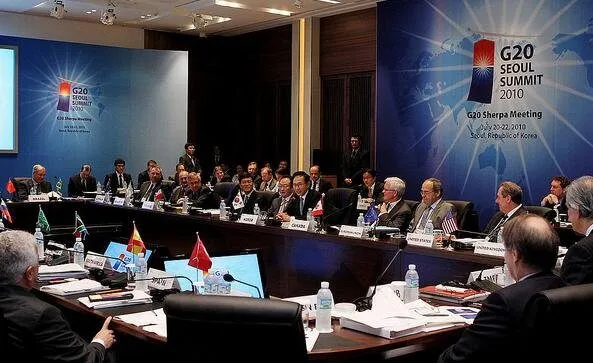
The 2008 global financial crisis forced a decisive expansion of the summit framework. When the G20 was elevated from a finance ministers’ forum to a leaders’ summit in November 2008 in Washington, it brought not only more nations to the table but also a fundamentally different communication challenge. With twenty major economies involved, the need for transparent, multilingual, and digitally accessible communication became urgent. The Pittsburgh Summit in 2009 was the first to feature a dedicated website with real-time updates, downloadable briefing documents, and multimedia content.
This transition coincided with the explosive growth of social media platforms. By the time France hosted the G20 in Cannes in 2011, the official summit Twitter account had become a primary channel for distributing communiqués and scheduling information. The era of the press pool as the sole intermediary between world leaders and the public was effectively over.
Live-Streamed Summits and Digital Transparency
The COVID-19 pandemic accelerated trends that had been building for a decade. The 2020 Riyadh Summit, held entirely virtually, was the first G20 leaders’ meeting conducted via video conference. Saudi Arabia’s presidency invested heavily in digital infrastructure, producing professional broadcasts of plenary sessions that were streamed simultaneously in multiple languages. This set a precedent that subsequent hosts—Italy in 2021, Indonesia in 2022, India in 2023—built upon, even as in-person meetings resumed.
India’s 2023 presidency under the “One Earth, One Family, One Future” theme demonstrated how far institutional communication had evolved. The official G20 India website featured interactive dashboards tracking working group outcomes, a dedicated mobile application, and an integrated social media strategy that reached over 200 million impressions across platforms. The New Delhi Declaration was published simultaneously in all official languages within minutes of its adoption.
The Role of Institutional Websites in Modern Governance
Today, the institutional web presence of international organizations is no longer a passive archive but an active instrument of governance communication. The G20’s rotating presidency model means that each host nation effectively builds a new digital ecosystem from scratch, often engaging specialized web agencies to develop platforms that must handle millions of visitors, support real-time translation, and meet stringent accessibility standards. This professionalization of institutional digital communication reflects a broader recognition that credibility in governance now depends, in part, on the quality and transparency of online engagement.
The shift has also created new challenges. The sheer volume of digital content produced during modern summits—press releases, backgrounders, side-event recordings, social media posts—can overwhelm rather than inform. Critics argue that the proliferation of communication channels has made it easier for governments to bury unfavorable outcomes beneath an avalanche of polished multimedia content. The paradox of digital transparency is that more information does not automatically mean more understanding.
Looking Ahead: AI, Multilingualism, and the Next Frontier
As the G20 prepares for the 2026 cycle under the United States presidency, several emerging trends are reshaping institutional communication once again. Artificial intelligence is being deployed for real-time translation of summit proceedings, potentially eliminating the delays that once characterized multilingual communication. Machine-generated summaries of lengthy policy documents are making complex negotiations more accessible to non-specialist audiences.
The fundamental question, however, remains unchanged since Rambouillet in 1975: how much should the public know about the deliberations of world leaders, and how should that knowledge be transmitted? The tools have changed beyond recognition, but the tension between diplomatic discretion and democratic transparency continues to define the communication strategies of every summit host. What has changed irrevocably is the expectation. In 2026, silence is no longer an option.
Want to understand the institutional difference between the G8 and the G20? Read our in-depth comparison: G8 vs G20. See also How the G8 is Structured and G8 Member Countries.