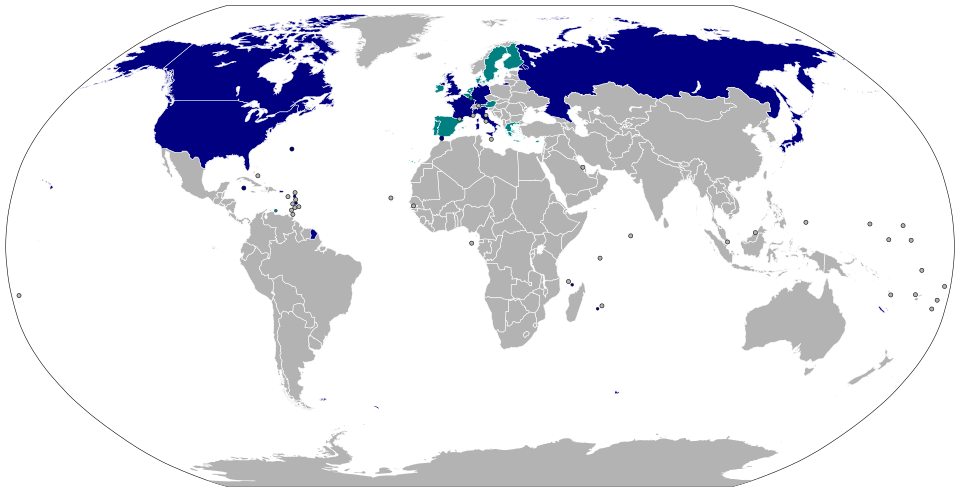
The G8 comprised eight of the world's most economically advanced nations. Together, these countries represented approximately 50% of global GDP and held enormous influence over international financial institutions, security arrangements and development policy. Understanding each member's role and perspective is essential to understanding how the G8 shaped global governance.
The Original Six (1975)
France — As the nation that initiated the first summit in 1975 under President Valéry Giscard d'Estaing, France has always considered the G8 a cornerstone of its multilateral diplomacy. France has consistently used its presidency to champion African development, climate policy and cultural diversity on the global stage.
United States — The world's largest economy has been the dominant voice in G8 discussions on global security, trade liberalisation and financial regulation. American presidents have used the summit both as a platform for advancing specific policy agendas and as an opportunity for bilateral meetings with other leaders on the margins.
United Kingdom — The UK has often positioned itself as a bridge between American and European perspectives within the G8. The 2005 Gleneagles Summit, hosted by Prime Minister Tony Blair, is widely considered the most impactful G8 summit in history, producing breakthrough commitments on debt relief for the world's poorest countries.
Germany — Europe's largest economy has brought a focus on fiscal discipline, trade and environmental policy to G8 discussions. Germany hosted the 2007 Heiligendamm Summit, which notably expanded outreach to major emerging economies through the “Heiligendamm Process.”
Japan — As the only Asian member, Japan brought a unique perspective on Pacific security, development in Asia and technology policy. Japan hosted key summits including the 2000 Okinawa Summit, which focused on the digital divide, and the 2008 Hokkaido Summit during the global food and energy crisis.
Italy — Italy has used its G8 membership to amplify its voice in international affairs beyond what its economic weight alone might command. The 2009 L'Aquila Summit, held in the earthquake-devastated Abruzzo region, produced the historic $20 billion food security initiative and demonstrated Italy's capacity to turn tragedy into diplomatic momentum.
Canada (1976)
Canada — Invited to join as the seventh member in 1976, Canada has consistently championed Arctic issues, human rights and development. The 2010 Muskoka Summit, hosted by Prime Minister Stephen Harper, launched the Muskoka Initiative on maternal, newborn and child health, mobilising $7.3 billion in new funding.
Russia (1998–2014)
Russia — Russia's admission to the G8 in 1998 was a geopolitical decision as much as an economic one, intended to anchor post-Soviet Russia within the Western institutional framework. Russia hosted its only G8 summit in St. Petersburg in 2006, focusing on energy security. Following the annexation of Crimea in March 2014, Russia was suspended indefinitely, and the group reverted to the G7 format.
The European Union
Though not a formal “member” in the traditional sense, the European Union has participated in G8 summits since 1977. The EU is represented by the Presidents of the European Council and the European Commission, bringing the collective weight of 27 member states to the table. The EU's presence ensures that issues of importance to smaller European nations are represented in G8 discussions, even when those nations are not directly at the table.
G8 Members at a Glance
The table below summarises the economic and demographic profile of each G8 member at the time of Russia’s suspension in 2014. The disparities are revealing: three members (the United States, Japan and Germany) together accounted for roughly 70% of the group’s total GDP, while Russia — the newest and most controversial member — contributed less than 4%.
| Country | Joined | GDP 2014 ($T) | Population (M) | Presidency |
|---|---|---|---|---|
| United States | 1975 (G6) | 17.4 | 319 | 2004, 2012, 2020* |
| Japan | 1975 (G6) | 4.6 | 127 | 2000, 2008, 2016, 2023 |
| Germany | 1975 (G6) | 3.9 | 81 | 2007, 2015, 2022 |
| United Kingdom | 1975 (G6) | 3.0 | 65 | 2005, 2013, 2021 |
| France | 1975 (G6) | 2.8 | 66 | 2003, 2011, 2019 |
| Italy | 1975 (G6) | 2.2 | 60 | 2001, 2009, 2017, 2024 |
| Canada | 1976 (G7) | 1.8 | 36 | 2002, 2010, 2018 |
| Russia | 1998 (suspended 2014) | 1.4 | 144 | 2006 |
GDP figures: World Bank, current US dollars. *G7 format after 2014.
The Question of Representation
One of the most persistent criticisms of the G8 was its limited representation. Eight countries, seven of them Western, claimed to speak for the global economy while excluding China (by 2014 already the world’s second-largest economy), India (1.3 billion people), Brazil and the entire African continent. This democratic deficit was not lost on the excluded. When the 2008 financial crisis demonstrated that Western economies could not stabilise the global financial system alone, the G20 was elevated to leaders’ level, effectively acknowledging what critics had argued for years: the G8 was too small to manage a global economy.
The G8’s defenders argued that its small size was precisely its advantage. A room with eight leaders can reach consensus in ways that a room with twenty cannot. The informality allowed frank discussion. The lack of a secretariat meant no institutional inertia. Whether this efficiency justified the exclusion of most of the world’s population remains an open question — one that the suspension of Russia in 2014 made largely academic.
For more analysis on international governance, explore our articles section.