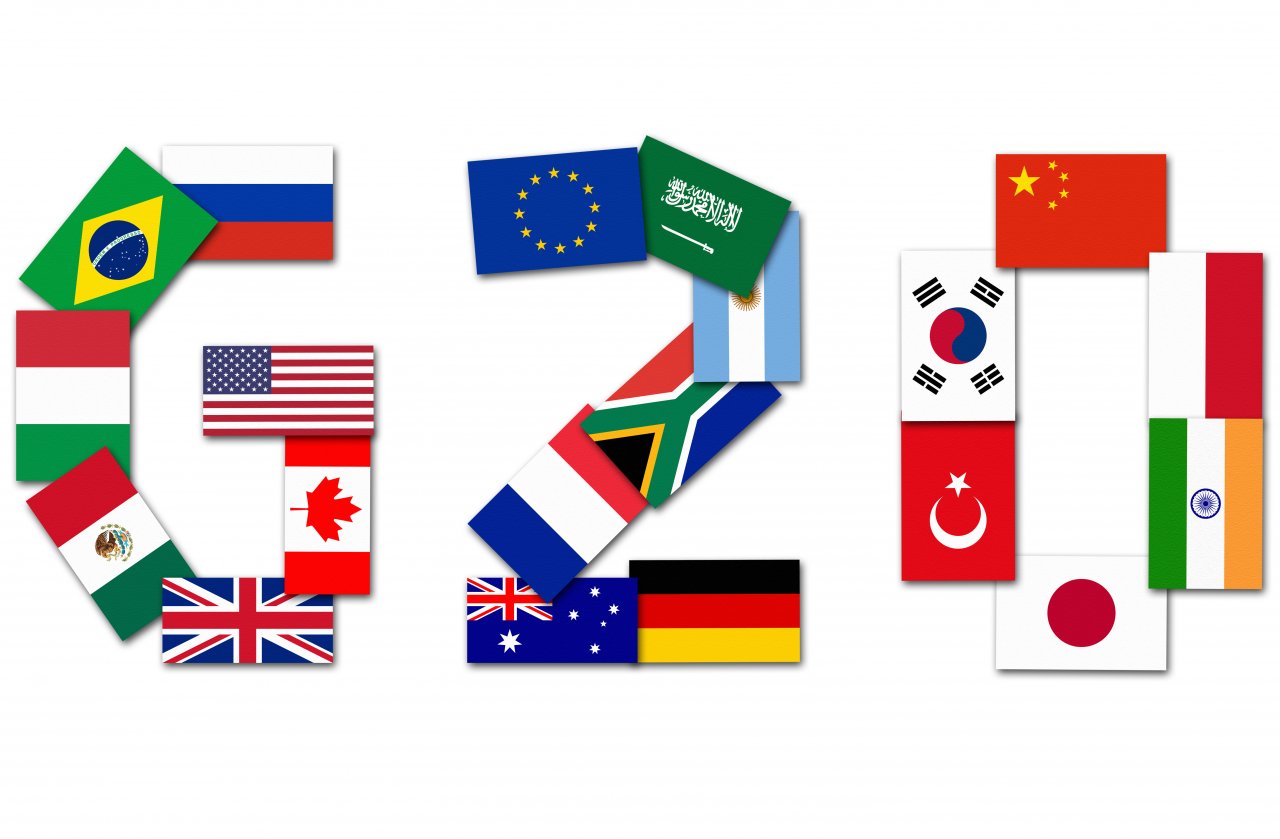
The G20 comprises 19 individual countries and the European Union, together representing the world's largest advanced and emerging economies. Unlike the G8, which was limited to Western industrialised democracies, the G20 spans every inhabited continent and includes nations at very different stages of economic development, from the world's largest economy (the United States) to rapidly growing emerging markets (India, Indonesia).
The 19 Member Countries
North America: United States, Canada, Mexico
The United States remains the G20's most influential member, with the world's largest nominal GDP. Canada brings a focus on Arctic issues and development. Mexico, admitted as the only Latin American member from North America, represents the world's 12th-largest economy.
Europe: France, Germany, Italy, United Kingdom, Türkiye, Russia
The European members bring the EU's regulatory influence to the table. Germany and France drive eurozone policy, the UK provides transatlantic perspective, Italy hosts key institutions, Türkiye bridges Europe and Asia, and Russia — though suspended from the G7 — remains a full G20 member.
Asia-Pacific: China, Japan, South Korea, India, Indonesia, Australia
This is the G20's most economically dynamic region. China and India are the world's fastest-growing major economies. Japan is the world's third-largest economy. South Korea, Indonesia and Australia each bring distinct regional perspectives.
South America: Brazil, Argentina
Brazil hosted the G20 presidency in 2024, bringing development, inequality and climate to the forefront. Argentina has used its membership to advocate for debt restructuring frameworks.
Africa and Middle East: South Africa, Saudi Arabia
South Africa is the only African member, giving it an outsized role in representing the continent's 1.4 billion people. Saudi Arabia brings the perspective of the world's largest oil exporter and hosted a pivotal virtual summit during the COVID-19 pandemic in 2020.
The European Union
The EU participates as the 20th member, represented by the Presidents of the European Council and the European Commission. The EU's participation ensures that the collective economic weight of 27 European nations (a combined GDP rivalling the United States) is fully represented, and brings the EU's extensive experience in regulatory harmonisation and multilateral negotiation.
Economic Weight
| Region | Members | Share of G20 GDP |
|---|---|---|
| North America | USA, Canada, Mexico | ~32% |
| Europe + EU | France, Germany, Italy, UK, Türkiye, Russia, EU | ~28% |
| Asia-Pacific | China, Japan, S. Korea, India, Indonesia, Australia | ~33% |
| South America | Brazil, Argentina | ~4% |
| Africa & Middle East | South Africa, Saudi Arabia | ~3% |
Guest Countries
Each G20 presidency invites additional guest countries. Spain has permanent guest status and participates in every summit. Other frequent guests include Singapore, the Netherlands, Chile and representatives from the African Union and ASEAN. This system allows the G20 to incorporate perspectives from countries not formally at the table while keeping the core group manageable.
G20 Members: Key Data
The table below shows each G20 member’s economic weight and population. The disparities within the group are enormous: the United States alone accounts for roughly a quarter of G20 GDP, while Argentina contributes less than 1%. This asymmetry shapes every negotiation — consensus requires the agreement of countries whose interests and capacities differ by orders of magnitude.
| Country | GDP 2024 ($T) | Population (M) | Last Presidency |
|---|---|---|---|
| United States | 28.8 | 335 | 2026 (upcoming) |
| China | 18.5 | 1,412 | 2016 |
| Germany | 4.6 | 84 | 2017, 2022 |
| Japan | 4.2 | 124 | 2019, 2023 |
| India | 3.9 | 1,442 | 2023 |
| United Kingdom | 3.5 | 68 | 2021 |
| France | 3.1 | 68 | 2011, 2019 |
| Italy | 2.3 | 59 | 2021, 2024 |
| Brazil | 2.2 | 216 | 2024 |
| Canada | 2.1 | 41 | 2018 |
| Russia | 2.0 | 144 | 2013 |
| South Korea | 1.7 | 52 | 2010 |
| Australia | 1.7 | 27 | 2014 |
| Mexico | 1.5 | 130 | 2012 |
| Indonesia | 1.4 | 278 | 2022 |
| Türkiye | 1.1 | 85 | 2015 |
| Saudi Arabia | 1.1 | 37 | 2020 |
| Argentina | 0.6 | 46 | 2018 |
| South Africa | 0.4 | 62 | 2025 |
| European Union | 18.3 | 449 | N/A |
GDP figures: IMF World Economic Outlook 2024, current US dollars. Population: UN estimates.
The Representation Problem
The G20 was designed to be more representative than the G7, and by raw numbers it is: its members account for roughly 85% of global GDP, 75% of world trade and two-thirds of the global population. But representation is not simply a matter of arithmetic.
Africa, home to 1.4 billion people across 54 countries, has a single seat: South Africa. The entire continent of Africa has the same representation as Canada (population 41 million). Latin America has two seats (Brazil and Argentina) but excludes Chile, Colombia and Peru — economies that are individually larger than many G20 engagement partners. The Middle East is represented by Saudi Arabia and Türkiye, leaving out Egypt, the UAE and Iran.
This structural imbalance is not academic. When the G20 discusses climate finance, the countries most affected by rising sea levels — small island developing states — are not at the table. When it discusses debt restructuring, the debtor nations are largely absent. The African Union’s admission as a permanent member in 2023 was a partial correction, but it also highlighted how long it took the forum to acknowledge the gap.
For more analysis on international governance, explore our articles section.