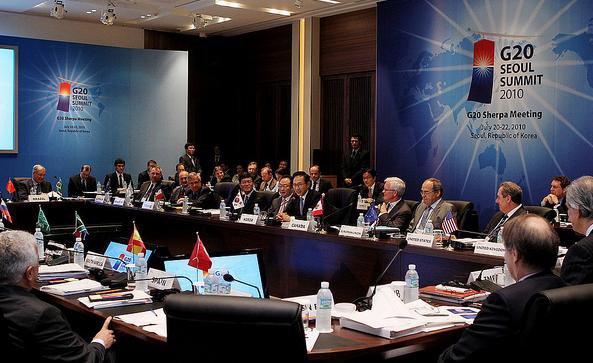
While our G8 vs G20 comparison examines this relationship from the perspective of the G8's evolution, this page explores why the G20 emerged as the dominant forum for international economic cooperation — and what that shift tells us about the changing dynamics of global power.
The Legitimacy Gap
By the mid-2000s, the G8 faced a fundamental legitimacy problem. Eight nations — representing less than 14% of the world's population and a shrinking share of global GDP — were making decisions that affected the entire planet. China, which had become the world's largest exporter and second-largest economy, had no seat at the table. Nor did India, Brazil, Indonesia or any African nation.
The G20 resolved this by including all major economies regardless of political system or geographic location. With 19 countries and the EU at the table, representing 85% of global GDP and 75% of trade, G20 decisions carry a legitimacy that the G8 could never claim.
The Crisis Test
The 2008 financial crisis was the decisive moment. When Lehman Brothers collapsed, the G8 finance ministers met but quickly recognised that any effective response required China (which held $2 trillion in US Treasury bonds), Saudi Arabia (the world's swing oil producer), and other major economies whose cooperation was essential to restoring global financial stability.
The first G20 leaders' summit in Washington (November 2008) and the London Summit (April 2009) demonstrated that the larger forum could act with speed and decisiveness. The $1.1 trillion package agreed in London — including massive new resources for the IMF and commitments to coordinated fiscal stimulus — would have been impossible without the participation of China, India and Saudi Arabia.
What the G20 Does Better
Economic governance: On financial regulation, international taxation, trade policy and development finance, the G20's broader membership makes its commitments more effective. A banking regulation agreed by 20 economies covering 85% of global GDP has far more impact than one agreed by 8.
Global representativeness: The G20 includes both sides of key global divides — developed and developing, North and South, Western and non-Western. This makes it better suited to address issues like climate finance, debt sustainability and vaccine equity that inherently require agreement between wealthy and developing nations.
Implementation capacity: Because the G20 includes the world's largest economies, its decisions on financial regulation, tax policy and trade can be implemented by its own members, covering the vast majority of global economic activity.
What the G8/G7 Still Does Better
The G8's smaller, more cohesive membership gives it advantages in areas requiring shared values and rapid political consensus. The G7 has been more effective on Russia sanctions coordination, support for Ukraine, defence of democratic values and responses to geopolitical crises — areas where China, Russia and Saudi Arabia are unlikely to agree with Western positions.
The Current Division of Labour
| Domain | Primary Forum | Why |
|---|---|---|
| Financial regulation | G20 | Requires global coverage |
| International taxation | G20 | All major economies must participate |
| Climate finance | G20 | Requires North-South agreement |
| Geopolitical crises | G7 | Requires shared democratic values |
| Sanctions coordination | G7 | Political alignment needed |
| Development policy | Both | G7 sets ambition, G20 broadens participation |
This complementary model reflects a mature understanding that different global challenges require different configurations of power. Neither forum alone can address the full range of 21st-century challenges — but together, the G7 and G20 provide a flexible architecture for international cooperation.
Related Analysis
For more analysis on international governance, explore our articles section.