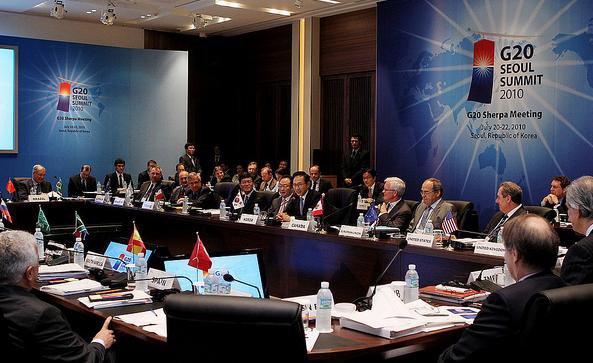
The G20's institutional architecture has evolved significantly since its elevation to leaders' level in 2008. While it retains the informal character inherited from the G8 model — no permanent headquarters, no charter, no standing secretariat — the G20 has developed a more complex organisational structure to manage the broader range of issues and the larger number of participants.
The Rotating Presidency and the Troika
The G20 presidency rotates annually among members, organised into five regional groups to ensure geographic balance. The host country assumes enormous responsibility: setting the year's agenda, organising dozens of ministerial and working group meetings, and hosting the leaders' summit.
To provide continuity, the G20 uses a “Troika” system: the current, previous and next presidency coordinate throughout the year. This ensures that initiatives launched under one presidency are carried forward by the next, preventing the loss of institutional memory that plagued the early years of the forum.
The Two Tracks: Finance and Sherpa
G20 work is organised into two parallel tracks. The Finance Track, led by finance ministers and central bank governors, handles macroeconomic policy, financial regulation, international taxation, infrastructure investment and financial inclusion. This track predates the leaders' summit and remains the G20's most technically rigorous process.
The Sherpa Track, led by personal representatives of the leaders (sherpas), handles everything else: trade, digital economy, anti-corruption, climate and energy, health, education and employment. The sherpa track has expanded considerably, reflecting the G20's growing ambition to address issues beyond traditional economic governance.
Working Groups
Both tracks operate through specialised working groups that meet multiple times throughout the year. Current working groups include the Framework Working Group (macroeconomic coordination), the International Financial Architecture Working Group, the Infrastructure Working Group, and the Sustainable Finance Working Group on the finance side, plus numerous groups under the sherpa track covering topics from digital economy to disaster risk reduction.
The Leaders' Summit
The annual leaders' summit, typically held in November, brings together heads of state and government for two days. By this point, most agreements have been pre-negotiated through the sherpa and finance tracks, allowing leaders to focus on politically sensitive issues and to provide the political impetus needed to finalise outstanding negotiations.
The summit produces a Leaders' Declaration — a consensus document covering all issues discussed during the year. While not legally binding, these declarations carry significant political weight and are typically implemented through existing international organisations.
Engagement Groups
The G20 has developed the most extensive system of engagement groups of any international forum. Seven official engagement groups — Business (B20), Civil Society (C20), Labour (L20), Think Tanks (T20), Women (W20), Youth (Y20) and Science (S20) — provide structured input throughout the year, presenting policy recommendations to leaders and participating in official side events. Some presidencies have added additional groups, such as the Urban 20 (U20) for mayors of major cities.
Guest Countries and International Organisations
Each G20 presidency invites guest countries (typically 2–3, often including Spain, which has permanent guest status, and representatives from Africa and Southeast Asia) and international organisations. The UN, IMF, World Bank, WTO, ILO, OECD, WHO and Financial Stability Board regularly participate, ensuring that G20 decisions are aligned with the broader multilateral system.
For more analysis on international governance, explore our articles section.