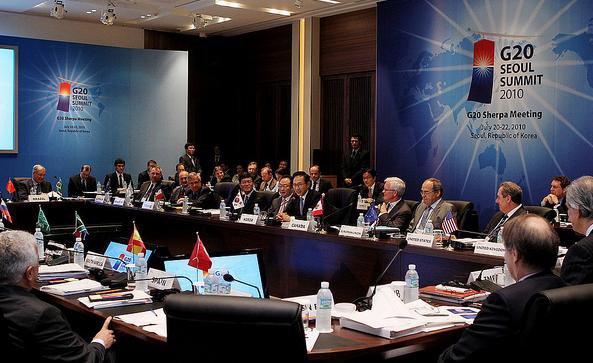
The G20's objectives have expanded considerably since its founding as a finance ministers' forum in 1999. What began as a narrow focus on preventing financial crises has evolved into a broad platform addressing financial regulation, international taxation, climate change, global health, digital transformation and sustainable development. Compared to the more politically-focused G8 objectives, the G20's agenda is centred on economic governance with global reach.
Financial Stability and Regulation
The G20's foundational objective — and its greatest achievement — is strengthening the global financial system. In response to the 2008 crisis, the G20 created the Financial Stability Board (FSB) to coordinate financial regulation across borders, and drove the implementation of Basel III, which significantly increased bank capital requirements and introduced new liquidity standards.
The G20 also led reforms of over-the-counter derivatives markets, introduced new rules for systemically important financial institutions (“too big to fail”), and established resolution frameworks to ensure that failing banks can be wound down without taxpayer bailouts. These reforms have made the global financial system measurably more resilient.
International Tax Reform
The OECD/G20 Base Erosion and Profit Shifting (BEPS) project, launched in 2013, represents the most comprehensive reform of international tax rules in a century. The initiative addresses strategies used by multinational corporations to shift profits to low-tax jurisdictions, and has resulted in over 135 countries agreeing to minimum standards for tax treaty abuse, country-by-country reporting and dispute resolution.
In 2021, the G20 endorsed the Two-Pillar Solution, including a global minimum corporate tax of 15% — a landmark agreement that aims to end the “race to the bottom” in corporate taxation and ensure that large multinationals pay a fair share of tax regardless of where they book their profits.
Climate and Energy Transition
G20 members collectively account for approximately 80% of global greenhouse gas emissions, making the forum crucial for climate action. The G20 has progressively strengthened its climate commitments, from acknowledging the scientific consensus on climate change to endorsing the Paris Agreement goals and committing to specific emission reduction targets.
The G20 Sustainable Finance Working Group develops frameworks for green finance, climate risk disclosure and transition planning. The forum has also addressed fossil fuel subsidies, with G20 leaders committing (repeatedly, if not always effectively) to phase out “inefficient” fossil fuel subsidies.
Pandemic Preparedness and Health
The COVID-19 pandemic demonstrated both the G20's potential and its limitations. On the positive side, the G20 mobilised unprecedented resources: the Debt Service Suspension Initiative (DSSI) provided $12.9 billion in relief for 48 countries, the G20 committed over $14 billion for COVAX vaccine access, and leaders agreed on a framework for future pandemic preparedness.
Digital Economy and Artificial Intelligence
Since 2016, the G20 has increasingly focused on the governance of the digital economy. The G20 AI Principles, adopted in 2019, were among the first international frameworks for responsible artificial intelligence. The Digital Economy Task Force addresses issues including cross-border data flows, digital inclusion, cybersecurity and the impact of automation on employment.
Development and Inequality
The G20 has expanded its development agenda significantly, particularly since the 2010 Seoul Summit introduced the Seoul Development Consensus. The G20 Compact with Africa, launched in 2017, promotes private investment in African countries. The Common Framework for Debt Treatment, agreed in 2020, provides a mechanism for restructuring the sovereign debt of low-income countries — a critical tool given the debt distress caused by the pandemic.
Related Analysis
For more analysis on international governance, explore our articles section.