On 24 March 2014, the leaders of the other seven G8 member countries announced that they would suspend Russia's participation in the G8 indefinitely. It was the most dramatic moment in the institution's nearly four-decade history — and it marked the end of the post-Cold War project to integrate Russia into the Western-led international order.
Background: Russia's Road to Membership
Russia's path to the G8 had been long and politically motivated. After Soviet President Mikhail Gorbachev attended the London G7 Summit in 1991, Russia was gradually integrated into the group through the 1990s. Full membership came at the Denver Summit in 1997, when the G7 officially became the G8.
Russia's inclusion was always primarily political rather than economic. In 1997, Russia's GDP was smaller than that of the Netherlands. The invitation was a reward for Boris Yeltsin's democratic reforms and a strategic attempt to anchor Russia within Western institutions, preventing a return to Cold War antagonism.
The Crimea Crisis: February–March 2014
The crisis began with Ukraine's Euromaidan revolution in February 2014. When Ukrainian President Viktor Yanukovych — who had rejected an EU Association Agreement under Russian pressure — fled to Russia, Moscow saw its strategic position in Ukraine threatened.
On 27 February, masked Russian soldiers without insignia (“little green men”) seized key government buildings in Crimea. Russia's parliament authorised the use of military force in Ukraine on 1 March. On 16 March, a hastily organised referendum — conducted under military occupation, without international observation, and boycotted by most Crimean Tatars and ethnic Ukrainians — returned a reported 96.77% vote in favour of joining Russia. On 18 March, President Vladimir Putin signed the treaty annexing Crimea.
The G7 Response
The international response was swift. On 2 March, the G7 foreign ministers issued a joint statement condemning Russia's military intervention. On 24 March, meeting on the margins of a nuclear security summit in The Hague, the G7 leaders issued a declaration that became the formal instrument of Russia's suspension:
“International law prohibits the acquisition of part or all of another state's territory through coercion or force. To do so violates the principles upon which the international system is built. We condemn the illegal referendum held in Crimea in violation of Ukraine's constitution. [...] We have decided that we will not attend the planned G8 Summit in Sochi.”
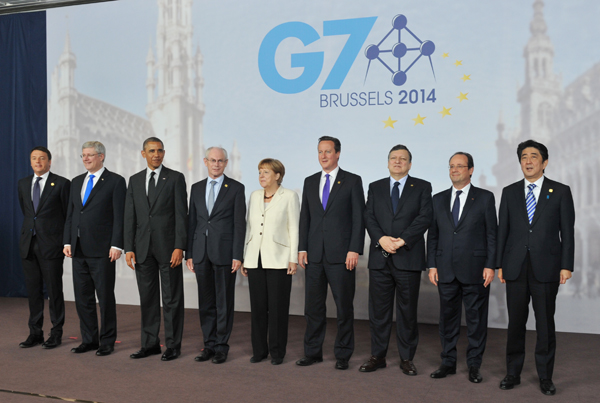
The planned G8 Summit in Sochi was cancelled and replaced by a G7 meeting in Brussels. The message was clear: Russia had violated the fundamental norms of sovereignty and territorial integrity that underpinned the international order — the same order that the G8 was created to uphold.
Why the Suspension Became Permanent
Initially, many observers expected the suspension to be temporary — a diplomatic punishment that would be lifted once tensions eased. Several factors made this impossible:
- Crimea was not reversed. Unlike past crises that could be managed through diplomacy, Russia's annexation of Crimea represented a permanent territorial change that violated international law. Readmitting Russia would mean accepting this violation.
- The conflict expanded. In April 2014, Russia-backed separatists seized parts of the Donbas region in eastern Ukraine. The shooting down of Malaysia Airlines Flight MH17 in July 2014, killing 298 people, further hardened Western opinion.
- Russia showed no willingness to reverse course. Rather than seeking reconciliation, Russia doubled down on its confrontational posture, intervening militarily in Syria in 2015 and engaging in election interference in the US and Europe.
- Full-scale invasion of Ukraine (2022). Russia's full-scale invasion of Ukraine on 24 February 2022 eliminated any remaining possibility of readmission. The G7 became the primary coordination mechanism for Western sanctions against Russia and military support for Ukraine.
Russia's Response
Russia has consistently maintained that its suspension was illegitimate and that the G8 format cannot legally exist without it. President Putin has repeatedly stated that Russia considers the suspension a Western political action rather than a legitimate institutional decision. In 2017, Russia's Foreign Ministry declared that Moscow had no interest in returning to what it called “this format.”
Impact on Global Governance
Russia's suspension had significant consequences for the broader architecture of global governance:
- It demonstrated that membership in informal forums like the G8 depends on adherence to shared norms, not just economic weight.
- It strengthened the G20 as the only major forum where Western and non-Western powers, including Russia, still sit at the same table.
- It reinforced the G7's identity as a values-based forum of democracies, clarifying its role relative to the more inclusive G20.
- It raised questions about whether other G20 members might face similar consequences for norm violations — a question with implications for the relationship between the G8/G7 and G20.
The Broader Lesson
Russia's suspension from the G8 illustrates a fundamental tension in global governance: between the pragmatic need to include major powers in governance arrangements and the normative foundation on which those arrangements rest. The G8 was created in part to manage Russia's integration into the Western order. When Russia fundamentally rejected the rules of that order, the institution's response — however painful — was a reaffirmation of the principle that membership carries obligations, not just privileges.
Related Analysis
For more analysis on international governance, explore our articles section.